
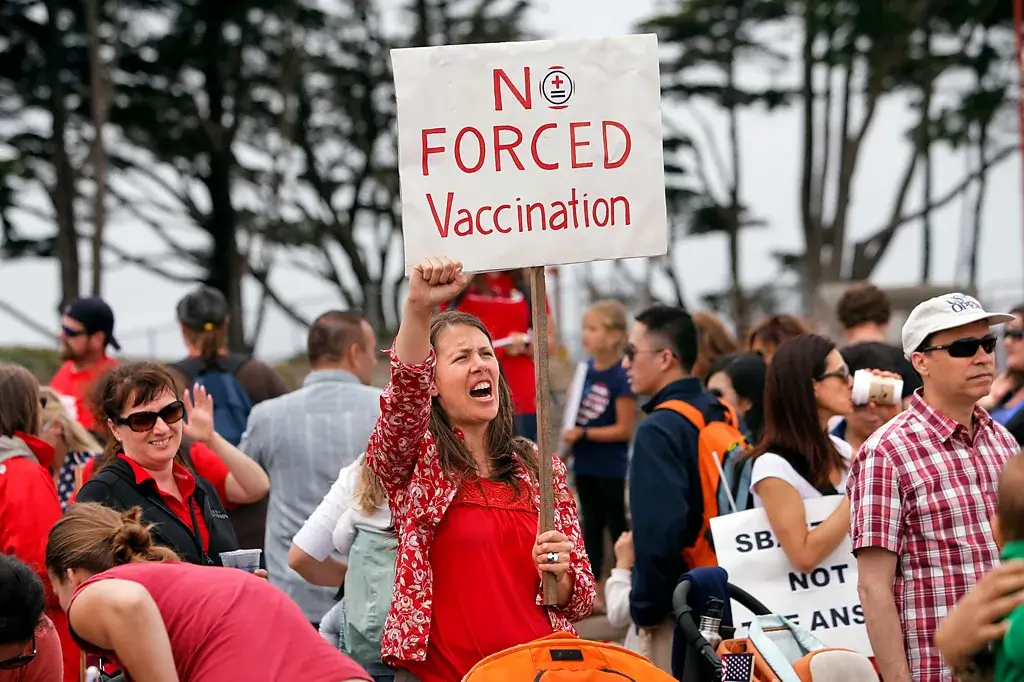
Vaccine scepticism may seem like a new, growing movement. It’s probably a lot older than you think.
Since the dawn of human history, our species has been besieged by terrible viruses and deadly plagues. Smallpox, a viral disease defined by a rash of painful pustules across the body, has been one of the most lethal of all, claiming an estimated 300 million lives over the 20th century alone.
The disease killed about one-third of those it infected. Of those who survived, one-third were left blind. Almost all were scarred for life. Neither riches nor geography were shields against the disease. Among its victims were Emperor Joseph I of Austria, King Louis I of Spain, Queen Mary II of England, King Louis XV of France and Tsar Peter II of Russia. By the 1800s, smallpox was killing more than 400,000 people a year around the world.
Comment & Analysis
David Robert Grimes is an adjunct assistant professor in public health at Trinity College Dublin and author of The Irrational Ape: Why we fall for disinformation, conspiracy theory, and propaganda. His work focuses on health disinformation and conspiracy theory.
And so, when UK doctor Edward Jenner developed the first version of the smallpox vaccine in 1796, he was hopeful that he might change history. He had observed that milkmaids were curiously immune to smallpox, likely because of their prior infection by cowpox – a related, but much less dangerous, virus. To test the idea that he could confer smallpox immunity this way, he took material from a milkmaid’s cowpox sore and injected it into the arm of an eight-year-old child – an experiment that would be unacceptable by the standards of modern medical ethics. The boy proved immune to smallpox infection. Jenner named the procedure after the Latin for cow, vacca – and the first vaccine was born.
“The annihilation of the smallpox, the most dreadful scourge of the human species, must be the final result of this practice,” Jenner wrote in 1801. And he would be proved right. In 1980, after a decades-long public health campaign that included widespread vaccination, the World Health Organization (WHO) declared smallpox had been eradicated. It remains the only infectious disease where this has been achieved.
A sleugh of other vaccines have been developed against other diseases, from influenza to human papillomavirus infections that cause certain cancers and the Sars-COV-2 virus behind Covid-19. In the past 50 years, an estimated 154 million lives have been saved by vaccines, according to one recent study.
Yet, opposition to vaccines – or hesitancy about accepting them – is widespread and on the rise in many parts of the world, even percolating into the uppermost branches of governments responsible for improving public health. This week, US health secretary Robert F Kennedy Jr was quizzed by the Senate Finance Committee over his vaccine policies, resulting in fiery exchanges. On the same day, the surgeon general of Florida also announced plans to end vaccine mandates in the state. (Read more about why vaccine distrust is on the rise.)
So, is this a recent phenomenon, or has distrust in vaccines been around for as long as the jabs themselves? Why do they face protests from relatively small, but vocal, segments of the public? And how have these arguments evolved? This is a look at the long, and strange history of the anti-vax movement.
Back in the early 1800s, a series of controlled experiments by Jenner and other doctors quickly showed inoculation to be extremely effective, granting immunity against smallpox in well over 95% of those vaccinated. Public health authorities worldwide took action to roll it out. In the UK, a series of Vaccination Acts, passed in 1840, 1853 and 1871, made immunisation for children first free, then compulsory.
But almost immediately, another challenge emerged: a spate of anti-vaccination leagues sprung up around the country.
They produced pamphlets with provocative and fittingly Victorian gothic titles, like Vaccination, a Curse and Horrors of Vaccination, anti-vaccination tracts, books and even periodicals, including The Anti-Vaccinator (1869) and The Vaccination Inquirer (1879).
Opposition to the idea of vaccination existed even before vaccines themselves
Think of the “anti-vaccination movement”, and you might envision the public protests, court cases or inflammatory claims about the Covid-19 vaccine. But there is a long history of protests against them, including anti-vaccine riots in 1850s England, 1880s Canada and 1890s America. In 1905 in Boston, US, vaccination opposition led to widespread protests and a Supreme Court case, which would go on to deem vaccine mandates constitutional.
Interestingly, opposition to the idea of vaccination existed even before vaccines themselves. Variolation – a precursor to modern immunisation, which used material from smallpox victims to induce a less serious reaction and immunity – was introduced in the UK and America in the 1720s.
It immediately drew the ire of critics. In a furious 1722 sermon entitled The Dangerous and Sinful Practice of Inoculation, English Reverend Edmund Massey insisted that diseases were divine retribution and punishment from God. Any measure to prevent smallpox was an inherently “diabolical operation” – one akin to naked blasphemy.
Religious opposition to vaccination was not the sole form of objection. After Jenner’s discovery of vaccination, one common trope was that immunisations should be avoided because they were “unnatural” – making vaccines the latest victim of the “appeal to nature” fallacy, a rhetorical technique that frames something as “good” by virtue of it being natural (and “bad” if it’s thought not to be). This isn’t a logical argument – arsenic, Ebola and uranium are perfectly natural but ill-advised additions to one’s breakfast cereal.
Some critics also believed that a vaccine might not just change your defences against a disease, but somehow transform your body itself. In one illustration from 1802, patients being inoculated for smallpox are shown turning into cows. This is among the origins of the “vaccines permanently alter your DNA trope”, says David Gorski, surgeon and editor of the publication Science-Based Medicine. “They didn’t know about DNA back then, obviously, but the idea that vaccines somehow change your very essence is an anti-vax trope that goes far back.”